


What Is Pebbledash and Why Is It a Problem?
Pebbledash is an exterior finish applied to millions of UK homes — predominantly from the 1920s through to the 1980s — in which small pebbles or gravel are thrown onto a wet render base coat and left to set. The result is a heavily textured, rough exterior that was popular for its durability and weather resistance at the time of application.
For modern homeowners, pebbledash creates a specific set of problems that smooth-rendered or brick properties don't face. The deeply textured surface absorbs and retains moisture far more than smooth finishes, making pebbledash homes particularly vulnerable to algae growth, damp penetration and freeze-thaw damage. Aesthetically, pebbledash is widely considered dated — and the options for dealing with it are more varied, and more misunderstood, than most contractors explain.
Pinnacle Wall Coatings has been treating pebbledash properties across England and Wales for over 30 years. This guide gives you the honest comparison of all four options.
Your Four Options for Pebbledash
When it comes to pebbledash, most homeowners are only ever told about two options — remove it or render over it. In reality there are four distinct routes, each with different costs, outcomes and suitability. Here is an honest summary of all four:
Not sure which option is right for your specific property? Our free survey assesses the condition of your pebbledash and gives you an honest recommendation — at no cost and with no obligation. Check if your property qualifies →
Option 1 — Coating Over Pebbledash: How It Works
Applying a wall coating directly over existing pebbledash is the route Pinnacle takes on the vast majority of pebbledash properties. It is the most cost-effective option for most homeowners and delivers a dramatic transformation. Here is exactly what the process involves:
Is the pebbledash suitable?
The starting point is always a substrate assessment. Our surveyor visits and carries out a tap test across all pebbledash elevations — tapping the surface with knuckles to identify any areas where the pebbledash has lost adhesion to the wall beneath. Firmly adhered pebbledash produces a solid sound; delaminating areas sound hollow.
Where pebbledash is firmly adhered across the majority of the property, coating directly over it is straightforward. Where isolated hollow areas are found, these can typically be treated as part of the preparation process. Where extensive delamination is present across large areas, we'll advise honestly on what additional work is needed before coating can be applied.
The preparation process
Once the substrate is confirmed as suitable, the preparation is thorough. The entire pebbledash surface is pressure-washed to remove algae, dirt, loose paint and surface contamination. Any loose or delaminating pebbles are treated. Cracks are repaired. All windows, doors, drives and planting are masked before any product is applied.
Primer application
A specialist primer is applied to all prepared pebbledash surfaces. This creates the bonding layer that ensures the coating adheres correctly to the irregular, textured pebbledash surface. The primer stage is critical on pebbledash because the surface geometry is more complex than smooth render — adequate primer coverage across the full texture is essential for long-term adhesion.
Coating application
The Wethertex coating is spray-applied in two passes across all primed surfaces. Because pebbledash has an irregular surface profile, spray application ensures consistent coverage across the peaks and recesses of the texture. The result — once complete — is a uniform, fully coated surface in your chosen colour.
The transformation
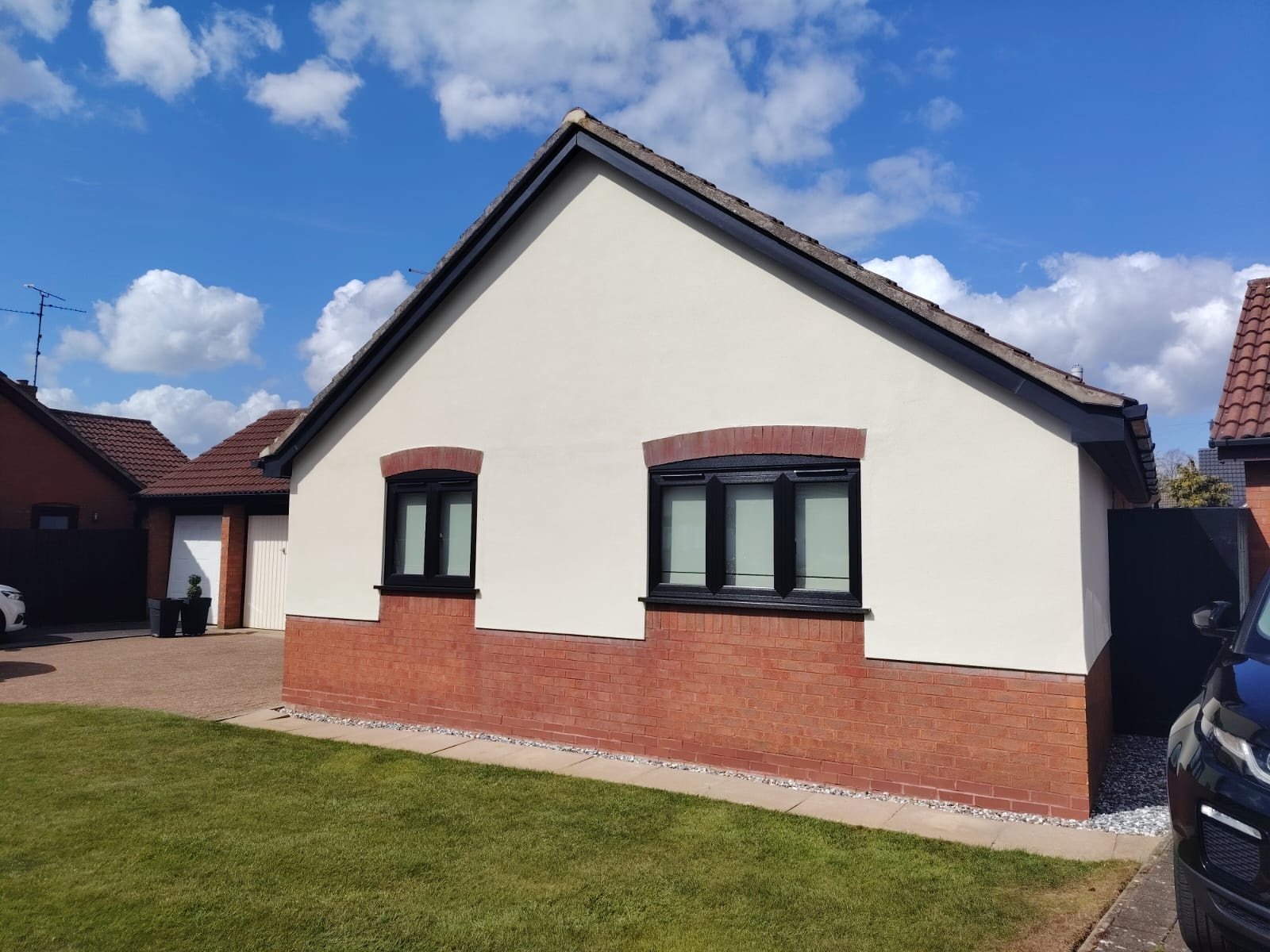
The visual result of coating over pebbledash is dramatic. The deeply textured, often stained and tired-looking pebbledash exterior is transformed into a clean, uniform, freshly coloured surface. The texture is still present — the surface profile of the pebbledash is visible in the finished coating — but it is completely covered, sealed and transformed. Neighbours regularly assume the pebbledash has been removed and the property fully re-rendered. It hasn't — the pebbledash is still there, now sealed and protected beneath the coating.
The texture of the pebbledash is part of the finished appearance — the coating follows the surface profile. If you specifically want a completely smooth flush finish, that requires rendering over or removing the pebbledash. Our surveyor can discuss colour and finish options at the free survey.
What Does Pebbledash Coating Cost?
Pinnacle wall coating prices for pebbledash properties are the same as for equivalent smooth-rendered properties. There is no additional charge for pebbledash — the preparation process accommodates it within the standard all-inclusive fixed price.
| Property Type | Pinnacle Wall Coating (all-in) | What's Included |
|---|---|---|
| 1 wall only | £3,500 – £5,000 | Scaffold, prep, primer, coating, guarantee |
| Semi-detached / bungalow | £5,000 – £8,000 | Full exterior, all preparation included |
| Small detached | £8,000 – £12,000 | All 4 elevations, scaffold, guarantee |
| Medium detached (3/4 walls) | £12,000 – £15,000 | All elevations, all preparation, guarantee |
| Large detached (4 walls+) | £15,000+ | Confirmed at free survey |
Option 2 — Rendering Over Pebbledash
Applying new silicone render over existing pebbledash is technically possible when the pebbledash is firmly adhered. However, there is an inherent risk that is important to understand: the render is only as good as the bond to the pebbledash, and the pebbledash is only as good as its bond to the wall. Any weakness in the pebbledash layer becomes a weakness in the render above it.
For this reason, many rendering contractors recommend pebbledash removal before rendering — which is the safer approach in terms of the render bond, but substantially more expensive. The removal cost (see below) is added to the rendering cost, making this one of the most expensive exterior treatments available for a pebbledash property.
Where a contractor does render over pebbledash without removal, get clarity on what their guarantee covers if the render fails at the pebbledash interface. The application itself may be fine but the underlying adhesion risk is real.
Cost of rendering over pebbledash
Rendering over pebbledash (without removal) costs approximately double the wall coating price for equivalent properties — typically £10,000–£16,000 for a semi-detached and £24,000–£30,000 for a medium detached. These figures are for silicone render including scaffold. For the full rendering cost breakdown see our rendering cost guide.
Option 3 — Pebbledash Removal
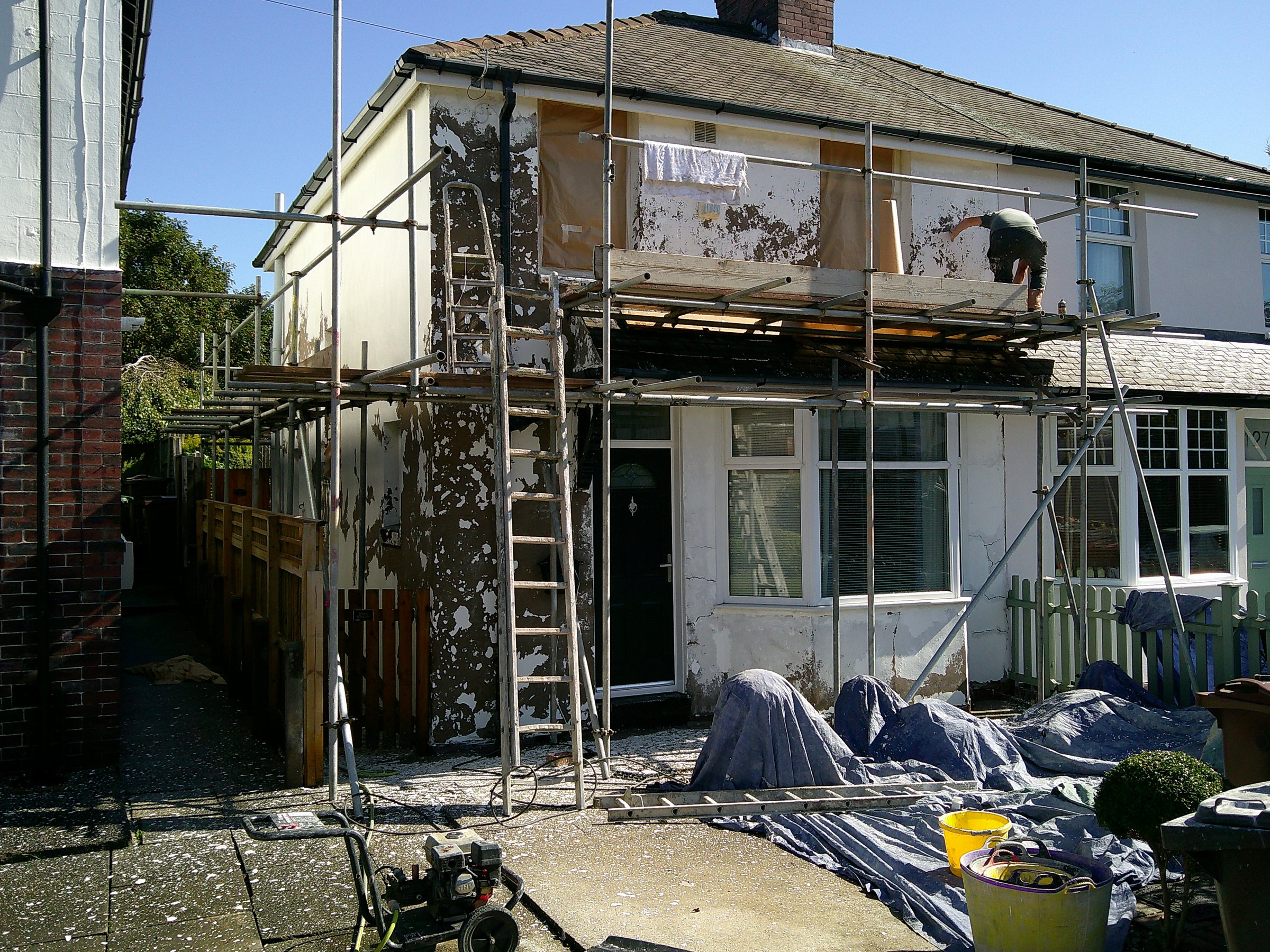
Pebbledash removal is the most invasive and expensive option — and the one most homeowners are surprised to discover they don't actually need. It is recommended by some contractors as a matter of routine, but in most cases where the pebbledash is structurally sound, removal is unnecessary and simply adds significant cost.
How pebbledash removal works
Removal involves physically hacking the pebbledash and its base coat from the wall face — a labour-intensive, messy process that exposes the underlying masonry. Once removed, the wall face typically requires significant repair before any new treatment can be applied. The removal debris creates substantial waste that needs to be disposed of.
Pebbledash removal cost
Pebbledash removal costs vary by property size, the thickness and adhesion of the original application, and regional labour rates. Typical costs across England and Wales:
| Property Type | Pebbledash Removal Only | Removal + Silicone Render | vs Wall Coating (no removal) |
|---|---|---|---|
| Semi-detached / bungalow | £2,000 – £5,000 | £13,000 – £23,000 | £5,000 – £8,000 |
| Small detached | £3,000 – £7,000 | £20,000 – £34,000 | £8,000 – £12,000 |
| Medium detached | £4,000 – £9,000 | £28,000 – £43,000 | £12,000 – £15,000 |
| Large detached | £5,000 – £12,000 | £35,000 – £55,000+ | £15,000+ |
The removal + render route can cost three to four times more than a wall coating for the same property — while delivering a similar outcome. The only situation where removal is genuinely necessary is where the pebbledash is extensively delaminating and cannot provide a sound substrate for any surface treatment. Our free survey assesses this honestly.
Option 4 — Painting Pebbledash
Masonry paint is the cheapest upfront option — but it performs worse on pebbledash than on any other exterior surface. The heavily textured pebbledash surface has dramatically more exposed area than smooth render, making it harder to achieve complete paint coverage and accelerating weathering and deterioration. Standard masonry paint on pebbledash typically lasts two to three years before peeling, fading and algae growth make repainting necessary.
Over 20 years, a medium detached pebbledash property repainted every three years costs £24,000–£45,000 cumulatively — considerably more than either a wall coating or silicone rendering. The only situation where painting makes sense is as a very short-term cosmetic improvement while a longer-term decision is being made.
For the full comparison of painting against wall coating see our wall coating vs masonry paint guide.
What If the Pebbledash Is Falling Off?
Pebbledash that is actively detaching from the wall — loose pebbles, sections pulling away, hollow-sounding large areas — needs to be assessed before any surface treatment is applied. The cause and extent of the failure determines which route is appropriate.
Isolated loose areas
Small areas of loose or delaminating pebbledash can typically be treated as part of the preparation process before a wall coating is applied. Our preparation team addresses these during the preparation stage. This is included in the fixed price — not a surprise addition.
Extensive delamination
Where large sections of pebbledash are pulling away from the wall face across multiple elevations, more substantial remedial work may be needed before any surface treatment can be applied reliably. Our surveyor assesses the extent at the free survey and advises honestly on what is required.
Structural causes
In some cases, pebbledash failure is caused by underlying issues — failed wall ties in cavity walls, significant moisture saturation, or substrate problems. These need to be identified and addressed before any exterior treatment is applied. If our surveyor identifies signs of a structural cause, they will advise accordingly.
Why Pebbledash Properties Are Prone to Damp
Pebbledash is significantly more porous than smooth render or brick. The gaps between the individual pebbles provide channels through which water can penetrate, and the large surface area — all those exposed pebble faces — means maximum exposure to wind-driven rain. Properties with untreated pebbledash are among the most vulnerable to penetrating damp in the UK.
This porosity is also why algae and green growth return so quickly to pebbledash properties. The irregular surface retains moisture, and the recesses between pebbles provide ideal sheltered conditions for algae to establish itself. North-facing pebbledash elevations in particular can turn visibly green within months of any surface treatment wearing off.
A wall coating applied over pebbledash solves both problems simultaneously — the coating creates a waterproof outer layer that prevents water penetration, while the algae inhibitor built into the Wethertex formula prevents regrowth. See our waterproofing exterior walls guide for more on how this works.
The Pebbledash Coating Process — What to Expect
Free Survey
Full tap test across all pebbledash elevations. Adhesion and condition assessed. Fixed all-in price confirmed.
Scaffold & Mask
Scaffold erected. All windows, doors, drives and planting fully masked before work begins.
Pressure Wash
Full pressure wash of all pebbledash surfaces. Algae, dirt and loose contamination removed.
Treat Loose Areas
Any isolated loose or delaminating pebbledash treated as part of preparation — included in price.
Prime
Specialist primer applied across all pebbledash surfaces for correct coating adhesion over the textured profile.
Coat
Wethertex coating spray-applied in two passes in your chosen colour. Consistent coverage across full texture.
Clean Up
All masking removed. Site left clean. Full snagging inspection completed.
20yr Guarantee
20-year no-quibble guarantee issued once you are fully satisfied with the completed work.
Total time on scaffold: 3–5 days for most properties.
Questions to Ask Before Any Pebbledash Work
- Has the surveyor carried out a full tap test across all elevations? A quote produced without physically assessing pebbledash adhesion is incomplete.
- Is removal genuinely necessary for my property? Many contractors recommend removal as a default. Ask why it's needed for your specific substrate condition.
- Is scaffolding included in the quoted price? Frequently excluded from headline pebbledash and rendering quotes.
- What does the guarantee cover and for how long? Get the terms in writing before any work begins.
- Will your own employees carry out the work? Or subcontractors?
- Have I compared a wall coating quote against this rendering/removal quote? The cost difference is typically substantial — always worth comparing before committing.
Coverage — England and Wales
Pinnacle covers all of England and Wales for pebbledash coating surveys and jobs. Whether you're in Wales, the South West, the Midlands, Yorkshire, the North West or anywhere else — our teams work in your area regularly. Use our suitability checker or call us free to confirm coverage for your specific postcode.
Comprehensive Guides — All Related Topics
Frequently Asked Questions
Yes — in the vast majority of cases. Provided the pebbledash is firmly adhered to the wall, we apply the coating directly over it after thorough preparation. Our surveyor carries out a full tap test at the free survey to confirm adhesion across all elevations. Where isolated loose areas are found, these are typically treated as part of the preparation process. Only where extensive delamination is present would more substantial remedial work be needed first.
A Pinnacle wall coating on pebbledash costs the same as on smooth render for equivalent property sizes — there is no additional charge for pebbledash. Prices range from £3,500–£5,000 for a single wall to £5,000–£8,000 for a semi-detached and £12,000–£15,000 for a medium detached. These are all-inclusive fixed prices covering scaffolding, preparation, primer, coating and the 20-year guarantee. The exact price is confirmed at the free survey.
The coating follows the existing surface profile — so the texture of the pebbledash is still present in the finished result, but completely covered and sealed in your chosen colour. The surface looks clean, uniform and transformed, but it is not completely smooth. Neighbours regularly comment that the house looks re-rendered when in fact the pebbledash is still there underneath. If you specifically want a completely flush smooth finish, that requires rendering over or removing the pebbledash.
Pebbledash removal typically costs £2,000–£5,000 for a semi-detached, £3,000–£7,000 for a small detached, and £4,000–£9,000 for a medium detached — before any new render or coating is applied. Added to the cost of silicone rendering, the total for a medium detached can reach £28,000–£43,000. By contrast, a wall coating applied directly over intact pebbledash costs £12,000–£15,000 all-in for the same property — typically three times less.
Not always — silicone render can sometimes be applied over firmly adhered pebbledash. However, many rendering contractors recommend removal because rendering over pebbledash carries an adhesion risk — the render is only as strong as the pebbledash bond beneath it. If your goal is to improve the exterior appearance and waterproof the walls, a wall coating applied directly over intact pebbledash achieves this without the cost and risk of removal.
Pebbledash is more porous than smooth render — the gaps between pebbles retain moisture and provide sheltered conditions where algae thrives. North-facing elevations are particularly prone because they receive less drying sunlight. Standard masonry paint contains no algae inhibitor, so the green growth returns quickly after painting. The Wethertex coating we apply contains an algae inhibitor built into the formula, and the smooth, sealed outer surface doesn't provide the grip that algae needs to establish itself.
The most important first step is a proper substrate assessment. Isolated loose areas are often treatable as part of a wall coating preparation process. Extensive delamination across large areas may require more substantial remedial work before any surface treatment can be applied reliably. Our free survey includes a full tap test across all elevations to identify the extent and cause of any pebbledash failure, and we'll advise honestly on what's needed before any commitment is made.
Where the damp is penetrating damp — caused by water entering through the porous pebbledash surface — yes. The coating creates a waterproof outer barrier that prevents water from penetrating the pebbledash. The coating is also breathable, so moisture already in the wall can continue to dry out after the coating is applied. If the damp has a different cause — rising damp or condensation — a wall coating will not resolve it. Our free survey includes a moisture assessment to help identify the source.
Yes — Pinnacle covers all of England and Wales for pebbledash coating surveys and jobs. Use our suitability checker or call us free on 0333 772 3623 to confirm coverage for your specific postcode and arrange a free no-obligation survey.
Find Out If Your Pebbledash Property Qualifies
Our free suitability checker takes less than 60 seconds. Book a free survey — our surveyor will assess your pebbledash, give you an honest recommendation, and provide a fixed all-in price. Covering all of England and Wales. No obligation to proceed.